

Most commercial solar business cases are built purely on electricity cost savings: system cost, divided by monthly savings, equals payback period. That math is real, but for many South African businesses it's missing the larger number entirely — the cost of load shedding itself, which rarely shows up as a line item anywhere in a standard financial model.
The Cost That Doesn't Show Up on a Power Bill
Downtime during an outage costs a business in ways that are real but easy to under-count: lost production time, spoiled stock (refrigeration, perishables), missed sales during trading hours, staff paid to stand idle, reputational cost of unreliable service, and in some sectors, contractual penalties for missed deadlines. None of that appears on an Eskom or municipal invoice, which is exactly why a pure bill-savings ROI calculation can understate the real value of solar-plus-battery for a business exposed to regular outages.
Two Numbers, Not One
A more complete commercial solar business case separates two distinct benefits:
- Direct savings — the reduced electricity bill from self-consuming solar generation, calculable the same way as any other energy-efficiency investment.
- Avoided downtime cost — harder to pin to an exact rand figure, but estimable by asking: what does an hour of lost trading, spoiled stock, or idle staff actually cost this specific business, and how many hours of load shedding does the business realistically experience per month?
Adding the second number to the ROI model, even as a conservative estimate, often shortens the effective payback period considerably compared to a bill-savings-only calculation — particularly for businesses in refrigeration-dependent, production-line, or customer-facing retail sectors where downtime cost is highest.
Why This Changes the System Design, Not Just the Justification
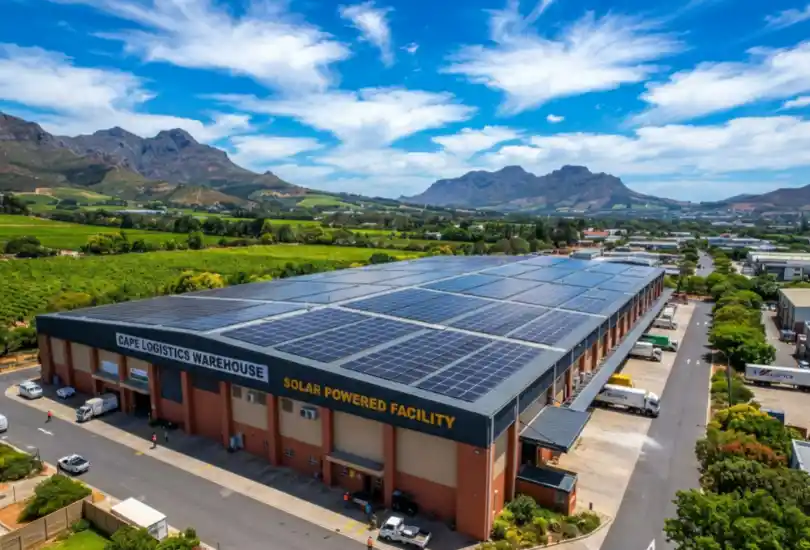
Once downtime cost enters the picture, the system needs battery capacity sized for continuity, not just panels sized for bill offset. A grid-tied, battery-less system can deliver strong bill savings but does nothing during an outage — meaning for a business where downtime cost is the bigger number, a pure bill-savings system misses the point of the investment even if it looks financially attractive on paper.
Sector Patterns Worth Knowing
- Refrigeration-dependent businesses (food retail, hospitality, some medical) tend to have the highest avoided-downtime value, since stock loss during outages is immediate and quantifiable
- Production-line and manufacturing operations often see load-shedding cost concentrated in restart time and lost output, not just the outage duration itself
- Customer-facing retail and service businesses frequently underestimate lost-sales cost during outage hours, since it's diffuse rather than a single visible loss event
Building the Case Properly
Before presenting a solar business case internally, it's worth pulling together: your current average monthly electricity spend, your business's realistic load-shedding exposure (hours per month, by current stage patterns), and a conservative estimate of downtime cost per hour specific to your operation. Combined with a load-profile-based system size (see our piece on why commercial solar ROI breaks down without a load profile), that gives a business case grounded in your actual numbers rather than a generic template.
Where to Start
Our solar calculator gives a reasonable starting estimate for system size and payback based on your usage — useful for an initial budget conversation, though a full commercial business case should layer your own downtime-cost estimate on top. When you're ready for proper commercial system design, compare installers experienced in business continuity sizing on ADEO.
Frequently Asked Questions
How do I estimate my business's downtime cost per hour of load shedding? Start with lost revenue during typical trading hours affected, add any spoiled-stock cost, and add staff cost for idle time — even a rough estimate is more useful in the business case than ignoring it entirely.
Does battery-backed solar eliminate load shedding risk completely? Only up to the battery's capacity and the essential circuits it's wired to — it reduces exposure significantly but isn't necessarily designed to run an entire operation indefinitely through every outage.
Should downtime cost be included in a formal ROI presentation to a CFO or board? Yes, but clearly labelled as an estimate separate from the harder, calculable direct savings number — mixing the two without distinction can undermine the credibility of the whole business case.

Writes about solar and renewable energy for South African homes and businesses at SolarTally, and cross-checks every guide against current tariffs and installer standards.


Popular on SolarTally